
Introduction
There is a particular kind of meal that every home cook is always searching for — one that feels genuinely satisfying, tastes like real cooking, and can be on the table in under thirty minutes without any stress. A meal that is good enough to make on a tired Tuesday evening but impressive enough to serve to a guest on a relaxed Saturday lunch. A meal that does not compromise on flavour in the name of speed, and does not sacrifice simplicity in the pursuit of something impressive.
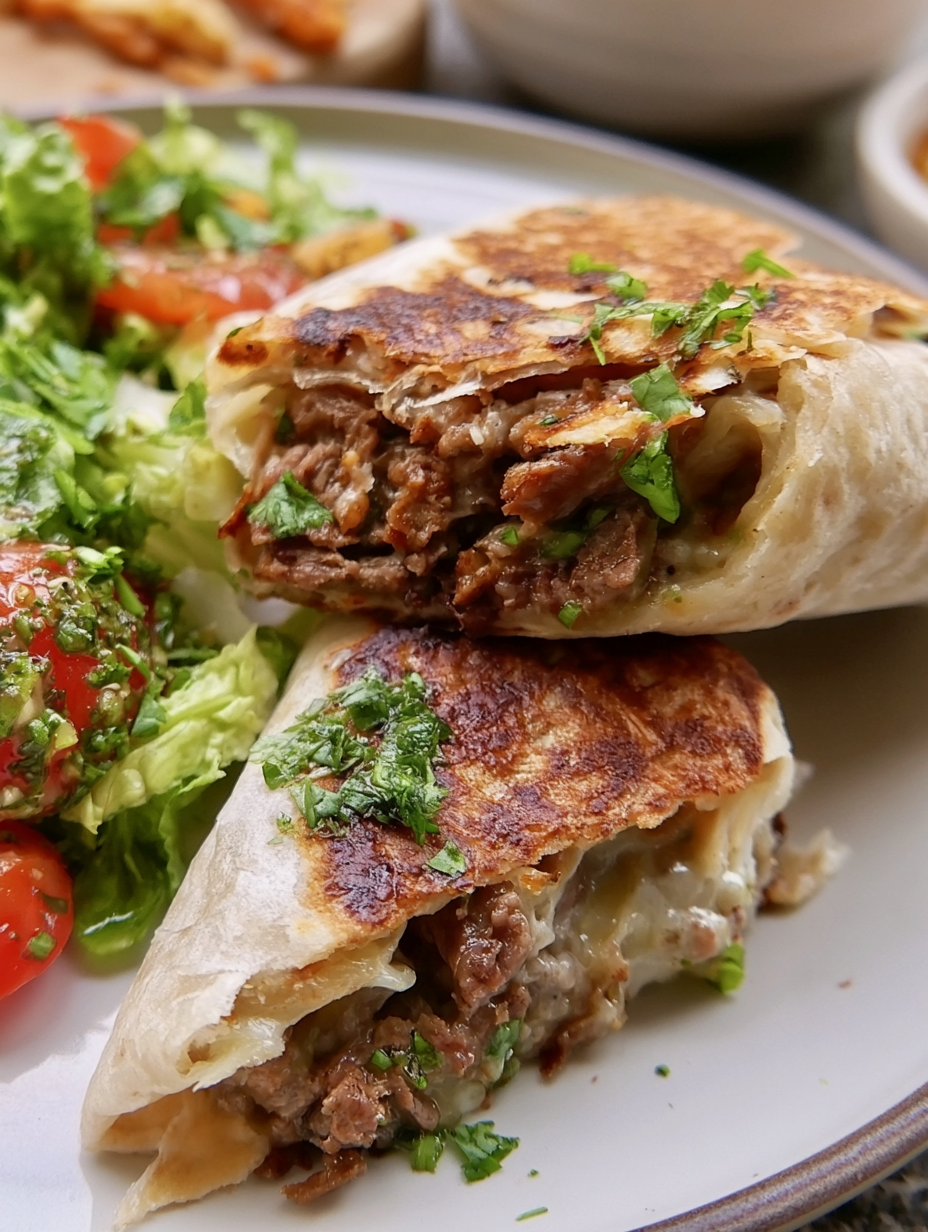
The Crispy Pan-Seared Beef Tortilla Wrap with a 5-Minute Romaine Salad is exactly that meal.
At its heart, this recipe is built on a beautifully simple idea: pair something warm, rich, and crispy with something cold, fresh, and bright. The tortilla wrap — stuffed with buttery garlic-and-shallot-seasoned beef and layered with melted Gouda cheese, then seared in butter until both sides are golden and crackling — is the warm, indulgent half. The romaine salad — crisp lettuce dressed simply in lemon juice, olive oil, and finely grated Parmesan — is the cool, refreshing counterpoint that makes every bite of the wrap taste even better.
Together, they create a meal that is balanced, deeply satisfying, and greater than the sum of its parts. This article will take you through every stage of the recipe in detail, exploring the ingredients, the techniques, and the reasoning behind each decision — so that when you make it, you make it with full confidence and get the best possible result.
Part One: The Philosophy of the Dish
Before stepping into the kitchen, it helps to understand what makes this particular combination of ingredients so effective.
The wrap itself is designed around contrast of temperature and texture. On the outside, the tortilla is golden-brown and crisp — seared in butter until it develops a delicate crunch. On the inside, the beef is tender, juicy, and savoury, fragrant with garlic, shallot, and fresh parsley. Between the beef and the tortilla, there are two layers of grated Gouda, which melt completely during cooking, creating a cheese layer that binds the filling together and adds a rich, slightly sweet, nutty flavour that Gouda is uniquely known for.
The double-tortilla technique — placing a smaller tortilla over the filling and then folding the larger tortilla’s edges over the top to create a sealed package — is particularly clever. It creates a sturdier, more structured wrap than a simple roll, prevents the filling from spilling out during searing, and results in a more even distribution of cheese and beef in every slice.
The romaine salad, meanwhile, is stripped back to absolute essentials: fresh lettuce, lemon, salt, pepper, olive oil, and Parmesan. This is not a salad trying to be complicated. It is a salad designed to do one specific thing — provide clean, fresh, bright flavour alongside the rich wrap — and it does that job perfectly.
Part Two: Ingredients
To make one large wrap and one generous salad (serving one to two people), you will need:
For the Ground Beef Filling:
- 1 tablespoon of butter (approximately 14 g)
- 2 garlic cloves, thinly sliced or finely grated
- 1 medium shallot, finely diced
- 450 g (1 lb) of ground beef
- Salt and black pepper to taste
- Fresh parsley, finely chopped
For the Tortilla Wrap:
- 1 large burrito-size flour tortilla
- 1 smaller flour tortilla
- Grated Gouda cheese, approximately half to three-quarters of a cup in total
- A little extra butter for pan-searing
For the 5-Minute Romaine Salad:
- 200 to 250 g of organic romaine lettuce, chopped into bite-sized pieces
- Juice of one quarter of a lemon (approximately 1 tablespoon)
- One eighth of a teaspoon of salt, or to taste
- Freshly ground black pepper to taste
- 2 tablespoons of extra virgin olive oil
- 20 to 30 g of finely grated Parmesan cheese
Part Three: Understanding the Key Ingredients
Every ingredient in this recipe has been chosen deliberately. Understanding why makes you a more confident, more instinctive cook.
Butter for the beef: Most beef recipes call for oil. Using butter here is a conscious choice that adds a subtle richness and nutty depth to the beef from the very first step. The milk solids in butter also help the garlic and shallot to caramelise more gently and evenly than they would in oil.
Garlic and shallot: This combination is the aromatic foundation of the beef filling. Garlic brings sharpness and depth; shallot brings a milder, sweeter, more refined onion flavour that blends seamlessly into the beef without overwhelming it. Together, they create a flavour base that is complex, fragrant, and deeply savoury.
Ground beef: The protein core of the dish. The recipe calls for cooking the beef until the moisture mostly evaporates and the meat is lightly browned but still juicy — a specific texture that is worth aiming for. Too wet and the filling will make the tortilla soggy; too dry and the beef loses its succulence. The goal is beef that is flavourful, slightly caramelised at the edges, and still tender in the centre.
Fresh parsley: Added at the very end of cooking, just thirty seconds before the heat goes off. This timing is deliberate — parsley added too early loses its fresh, vibrant quality and becomes dull and slightly bitter. Added at the end, it retains its bright, clean flavour and adds a pop of freshness and colour to the finished filling.
Gouda cheese: An inspired choice for this recipe. Gouda is a semi-hard cheese with exceptional melting properties — it becomes wonderfully smooth and fluid when heated, without becoming greasy or stringy. Its flavour is mild, slightly sweet, and nutty, which complements the savoury beef without competing with it. The cheese is used in two layers — beneath and above the beef — ensuring an even distribution of melted cheese throughout every bite.
Romaine lettuce: One of the sturdiest, crunchiest lettuces available, romaine holds up beautifully to a dressing without wilting immediately. Its firm, crisp texture provides the perfect contrast to the soft, warm wrap, and its mild, slightly bitter flavour is a clean complement to the richness of the beef and cheese.
Parmesan in the salad: Finely grated Parmesan adds a salty, savoury, umami-rich element to the salad that elevates it far beyond a simple dressed lettuce. A light dusting of good-quality Parmesan is one of the most effective flavour additions you can make to a simple salad.
Part Four: Cooking the Beef Filling
The beef filling is the soul of this recipe. It is simple to make, but the details matter.
Step 1: Building the Aromatic Base
Melt one tablespoon of butter in a wide skillet over medium heat. Watch the butter as it melts — when it begins to foam, add the sliced or grated garlic. Cook for thirty seconds, stirring constantly. Garlic can burn very quickly, particularly when sliced thinly, so keep the heat at medium and do not walk away.
After thirty seconds, add the finely diced shallot. Stir to combine with the garlic and butter. Cook for one to two minutes, stirring occasionally, until the shallot has softened and become slightly translucent and glossy. At this point, the pan will smell extraordinarily good — the combination of butter, garlic, and shallot is one of the most enticing aromas in cooking.
Step 2: Cooking the Beef
Add the ground beef to the pan. Using a spatula, break it up into small, even pieces and spread it across the surface of the pan to encourage browning rather than steaming. Cook over medium heat for five to seven minutes, stirring occasionally.
The key instruction here — cook until the moisture mostly evaporates and the meat is lightly browned but still juicy — deserves attention. Ground beef releases a significant amount of liquid as it cooks. If you stir it constantly, it will steam rather than brown. Allow it to sit undisturbed for a minute or two between stirs, giving the meat contact with the hot pan and the opportunity to develop some golden, caramelised edges. When most of the liquid has evaporated and the beef is lightly browned in places, it is ready.
Step 3: Seasoning and Finishing
Season generously with salt and freshly ground black pepper. Taste as you go — well-seasoned beef is the difference between a filling that is merely good and one that is genuinely delicious.
Add the chopped fresh parsley, stir it through the beef, and cook for just thirty seconds. Remove the skillet from the heat immediately. The parsley will perfume the entire filling with its fresh, bright fragrance and add a beautiful green fleck to the rich brown beef.
Part Five: Assembling and Cooking the Wrap
The assembly process for this wrap is slightly more involved than a standard burrito roll, but the result — a flat, sealed package that sears evenly on both sides — is well worth the extra thirty seconds of effort.
Step 1: Setting Up
Place the large flour tortilla in a small skillet. Allow the edges of the tortilla to drape up the sides of the pan. This is not the cooking stage yet — the skillet simply acts as a mould that will help you see how much of the tortilla you have to work with when folding.
Step 2: Layering the Filling
Spread a layer of grated Gouda cheese across the centre of the tortilla. The cheese goes down first, directly onto the tortilla — as it melts, it will act as an adhesive layer that binds the beef to the tortilla and prevents it from sliding around inside the finished wrap.
Spoon approximately half of the warm beef filling on top of the cheese, spreading it evenly across the centre. Then add another layer of grated Gouda directly on top of the beef. This second cheese layer will melt down through the beef from above, ensuring that the cheese and beef are thoroughly interwoven throughout the filling rather than existing as separate layers.
Step 3: The Double Tortilla Technique
Place the smaller flour tortilla directly on top of the filling, covering it completely. This inner tortilla creates a firm base for the wrap and provides additional structure that a single tortilla cannot offer.
Now fold the hanging edges of the larger tortilla over the smaller one, working your way around the circumference of the wrap. Start from one side, fold it over firmly, then work clockwise (or anticlockwise) until all the edges are folded in and the package is completely sealed. Press down gently but firmly to compact the package.
Step 4: Pan-Searing
Carefully flip the sealed wrap so the folded seam side is facing down. This ensures that the folds are pressed shut by the weight of the filling during the first side of cooking, sealing the wrap securely.
If the pan appears dry, add a small knob of butter to the pan and allow it to melt. Cook the wrap over medium heat for approximately three minutes on the first side, pressing gently with a spatula to ensure full contact with the pan, until the bottom is deep golden-brown and crisp.
Carefully flip the wrap — using a wide spatula or two spatulas for confidence — and cook the second side for a further two to three minutes until equally golden. At this point, the Gouda inside will have melted completely, the tortilla will be crisp and fragrant, and the aroma filling the kitchen will be almost unbearably good.
Part Six: The 5-Minute Romaine Salad
While the wrap is cooking — or immediately before serving — prepare the salad. It takes no more than five minutes and requires no cooking whatsoever.
The Dressing
This salad uses one of the simplest and most effective dressings in all of cooking: lemon juice, salt, pepper, and extra virgin olive oil. The proportions here — one tablespoon of lemon juice to two tablespoons of olive oil — create a dressing that is bright and slightly acidic, with enough fat to coat the lettuce and carry the Parmesan flavour to every leaf.
The quality of the olive oil matters here. Since this salad is so simple, every ingredient is visible and tasted clearly. Use the best extra virgin olive oil you have — fruity, grassy, and aromatic — and it will transform the salad entirely.
Building the Salad
Place the chopped romaine in a serving bowl. Squeeze the lemon juice directly over the leaves, then season with salt and pepper. Drizzle with olive oil. Add the finely grated Parmesan.
Toss the salad gently but thoroughly, making sure every leaf is lightly coated in the dressing and dusted with Parmesan. Do not dress the salad too far in advance — the lemon juice will begin to wilt the leaves after a few minutes, and this salad is best eaten immediately after dressing.
Part Seven: Serving
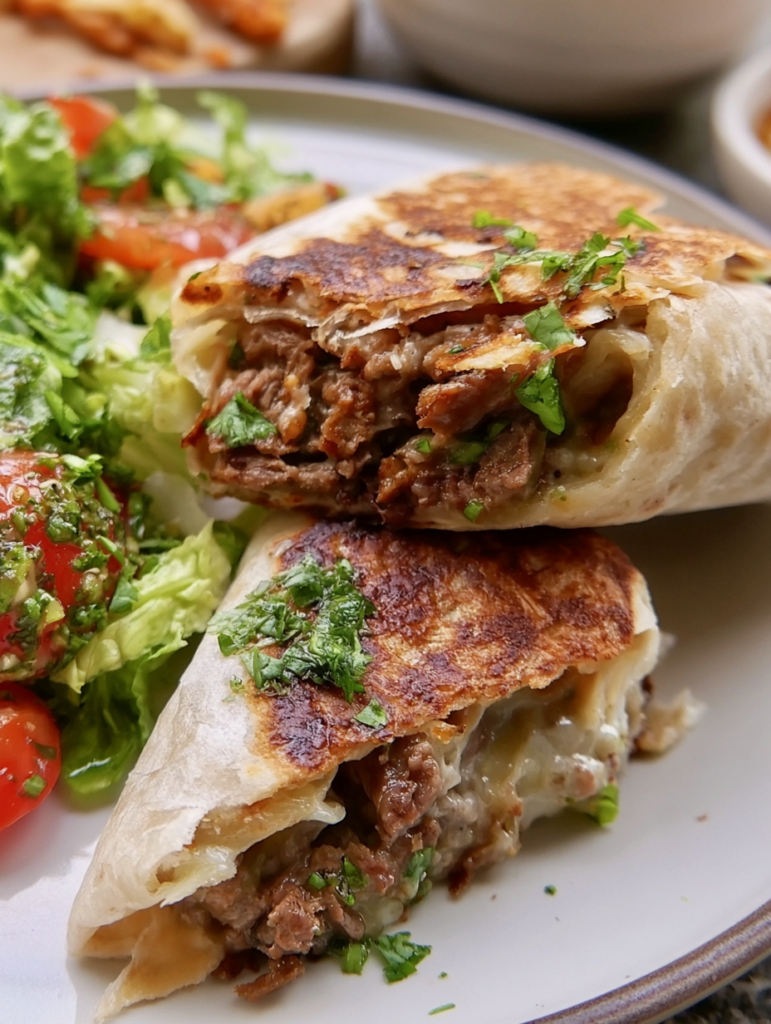
Remove the wrap from the pan and place it on a cutting board. Allow it to rest for thirty seconds — this brief rest allows the melted cheese inside to set very slightly, making slicing cleaner. Then slice it in half or into portions. The cut reveals a beautiful interior: layers of golden tortilla, melted cheese, and juicy, fragrant beef — all fused together into a compact, satisfying package.
Serve the warm, crispy wrap immediately alongside the cold, freshly dressed romaine salad. The contrast between the two — hot and cold, rich and fresh, crispy and crisp in entirely different ways — is the defining experience of this meal. Each element makes the other taste better. The richness of the wrap makes the freshness of the salad feel more vivid; the brightness of the salad makes the warmth and depth of the wrap feel more comforting.
This is balance. This is what good recipe design looks like.
Part Eight: Tips for the Best Results
Do not overcook the garlic. Thirty seconds is genuinely enough. Burnt garlic is bitter and will taint the entire filling. Keep the heat at medium and keep stirring.
Season the beef generously. Ground beef needs confident seasoning to taste its best. Taste the filling before assembling the wrap and adjust accordingly — a well-seasoned filling is the foundation of a great wrap.
Use the double tortilla technique. It may seem like an extra step, but it creates a much sturdier, better-structured wrap that holds together perfectly during searing and slicing. Do not skip it.
Press during searing. Gentle, consistent pressure from a spatula ensures full contact between the tortilla and the pan, resulting in even, deep golden browning rather than patchy, uneven colour.
Dress the salad at the last moment. Romaine is robust, but it will begin to wilt under the lemon juice after a few minutes. Dress it just before serving for the best texture and freshness.
Use finely grated Parmesan. The key word is finely. Finely grated Parmesan distributes evenly over the leaves and melts slightly into the dressing, coating every piece of lettuce. Coarsely grated Parmesan clumps and does not integrate in the same way.
Conclusion
The Crispy Pan-Seared Beef Tortilla Wrap with a 5-Minute Romaine Salad is a masterclass in the idea that simplicity and quality are not opposites — they are partners. Every element of this recipe is simple. The techniques are accessible to any home cook. The ingredients are easy to find in any supermarket. And yet the finished meal is genuinely, memorably delicious.
The secret, as with so many great recipes, lies not in complexity but in attention — to the quality of the ingredients, to the details of the technique, and to the balance between the components. The warm, crispy, cheese-filled wrap and the cold, bright, Parmesan-dusted salad were made for each other, and eating them together is one of those small, genuine pleasures that good cooking can produce.
Make it tonight. You will be very glad you did.
Enjoy every bite!
Print
Crispy Pan-Seared Beef Tortilla Wrap with a 5-Minute Romaine Salad: The Perfect Quick Meal
Ingredients
For the beef filling: 450g ground beef, 1 medium shallot finely diced, 2 garlic cloves sliced or grated, 1 tbsp butter, fresh parsley chopped, salt and black pepper to taste.
For the wrap: 1 large burrito-size flour tortilla, 1 smaller flour tortilla, half to three-quarters cup grated Gouda cheese, a little extra butter for searing.
For the romaine salad: 200–250g romaine lettuce chopped, 2 tbsp extra virgin olive oil, 20–30g finely grated Parmesan, juice of a quarter lemon, salt and black pepper to taste.
Instructions
Melt the butter in a skillet over medium heat. Add the garlic and cook for 30 seconds, then add the shallot and cook for 1 to 2 minutes until soft. Add the ground beef, break it apart, and cook for 5 to 7 minutes until the moisture evaporates and the meat is lightly browned. Season with salt and pepper, add the parsley, stir for 30 seconds, then remove from heat.
To assemble the wrap, place the large tortilla in a small skillet letting the edges hang over the sides. Add a layer of Gouda in the centre, then half the beef filling, then another layer of Gouda. Place the smaller tortilla on top, then fold the edges of the large tortilla over it to seal the package completely. Flip it so the seam side faces down. Add a little butter if needed and cook over medium heat for about 3 minutes until golden, then flip and cook the other side for 2 to 3 minutes until both sides are crispy and the cheese is fully melted inside.
For the salad, place the chopped romaine in a bowl. Add the lemon juice, salt, pepper, and olive oil, then sprinkle the Parmesan on top and toss gently until every leaf is coated. Dress it just before serving.
Slice the wrap and serve it hot alongside the fresh salad.
Notes
The magic of this meal is in the contrast — the warm, crispy, cheese-filled wrap paired with the cold, bright salad. Do not dress the salad until the very last moment to keep the lettuce crisp, and always serve the wrap straight from the pan while the exterior is still at its crunchiest.